
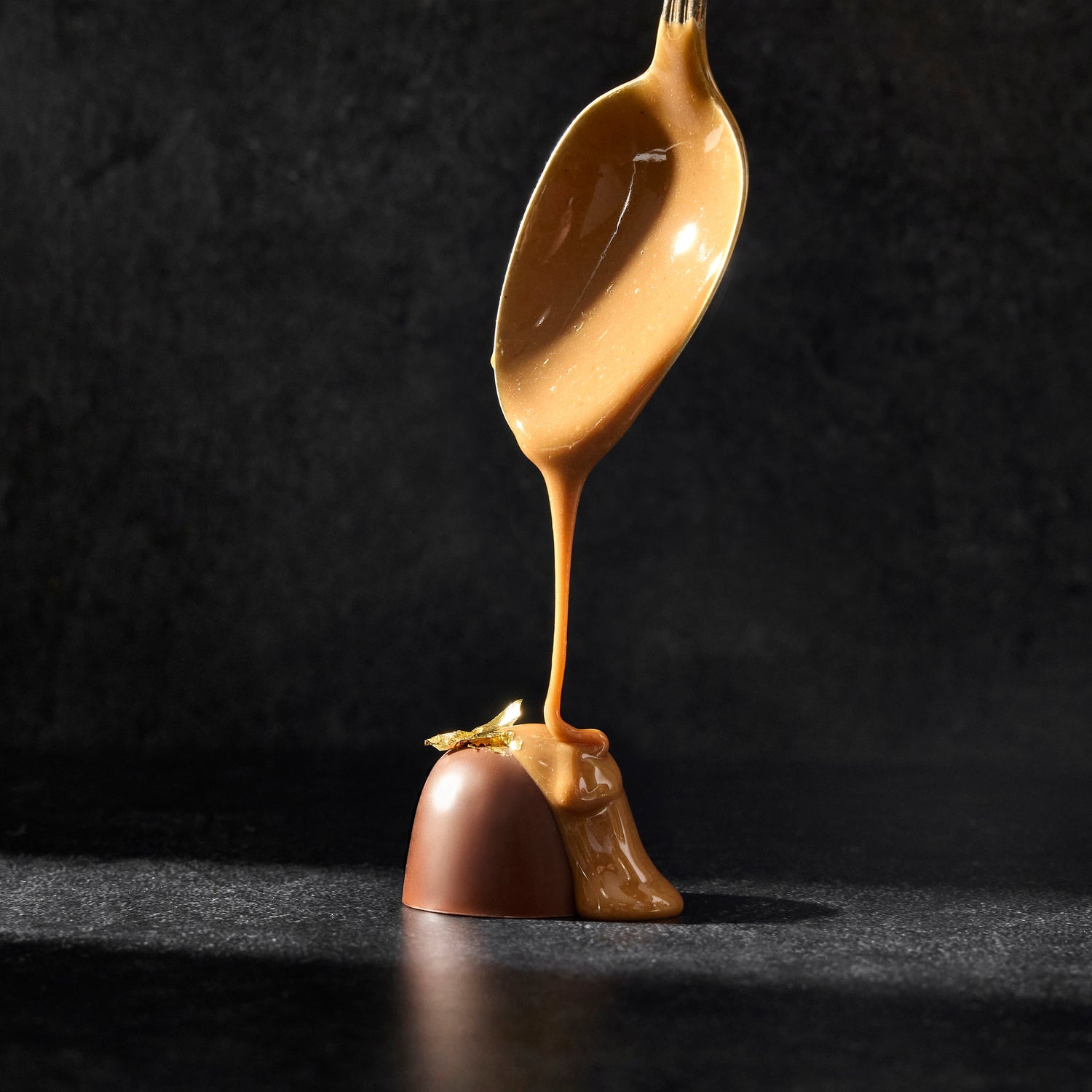
Gianduia chocolate is made by blending chocolate with finely ground hazelnuts.
Gianduia emerged in Piemonte during the Napoleonic period, when cocoa became scarce under trade restrictions. Chocolate makers in Turin began blending chocolate with finely ground local hazelnuts from the Langhe hills, creating a composition that behaved differently from solid chocolate from the beginning.
The hazelnuts of the Langhe region are central to this transformation.
Grown in the hills surrounding Alba, within a landscape recognized as a UNESCO World Heritage site, they are valued for their aroma, sweetness, and high oil content.
Many are protected under the Nocciola Piemonte I.G.P. certification, which identifies hazelnuts cultivated within specific areas of Piemonte according to regulated standards of quality and origin.
The result is a composition that holds less rigidly than solid chocolate and begins to soften earlier in contact.
The presence of hazelnut changes the structure before any flavor is identified.
There is less resistance at the surface.
The interior does not feel separate from the exterior.
Their character is shaped before processing begins, through soil, climate, and cultivation.
When roasted, they release oils that carry both aroma and texture into the chocolate.
Grinding determines how the composition behaves.
A coarse grind leaves friction.
A fine grind removes it.
Traditionally, the mixture is refined between rotating granite stones.
The pressure reduces both chocolate and hazelnut into particles small enough that they are no longer individually perceived.
Particle size is often reduced below 20 microns.
At that scale, texture is no longer experienced as grain or separation.
The composition begins to feel continuous.
When the paste becomes fully smooth, it no longer interrupts the chocolate, but integrates into it.
At that point, the mixture is no longer divided into layers.
It becomes continuous.
This continuity changes how the chocolate is perceived.
There is no clear point where chocolate ends and hazelnut begins.
Both are present from the first moment, though not equally noticeable.
In pralines, this is easier to observe.
In much of Europe, praline refers broadly to filled chocolate bonbons containing hazelnut or nut pastes.
The oils released from the hazelnut do not remain separate from the cocoa butter.
They alter how the chocolate moves and softens as temperature changes.
Gianduia is often paired with inclusions that interrupt this continuity.
Whole roasted hazelnuts, feuilletine, cocoa nibs, or pieces of caramelized nut introduce resistance back into the composition.
A whole hazelnut placed on top introduces contrast, not in flavor, but in structure.
One remains intact.
The rest moves.
As the piece warms, the composition becomes more fluid.
The hazelnut begins to carry more of the flavor.
The chocolate softens around it rather than over it.
What remains is not the sensation of chocolate beside hazelnut,
but the gradual disappearance of separation between them.


Leave a comment
This site is protected by hCaptcha and the hCaptcha Privacy Policy and Terms of Service apply.