
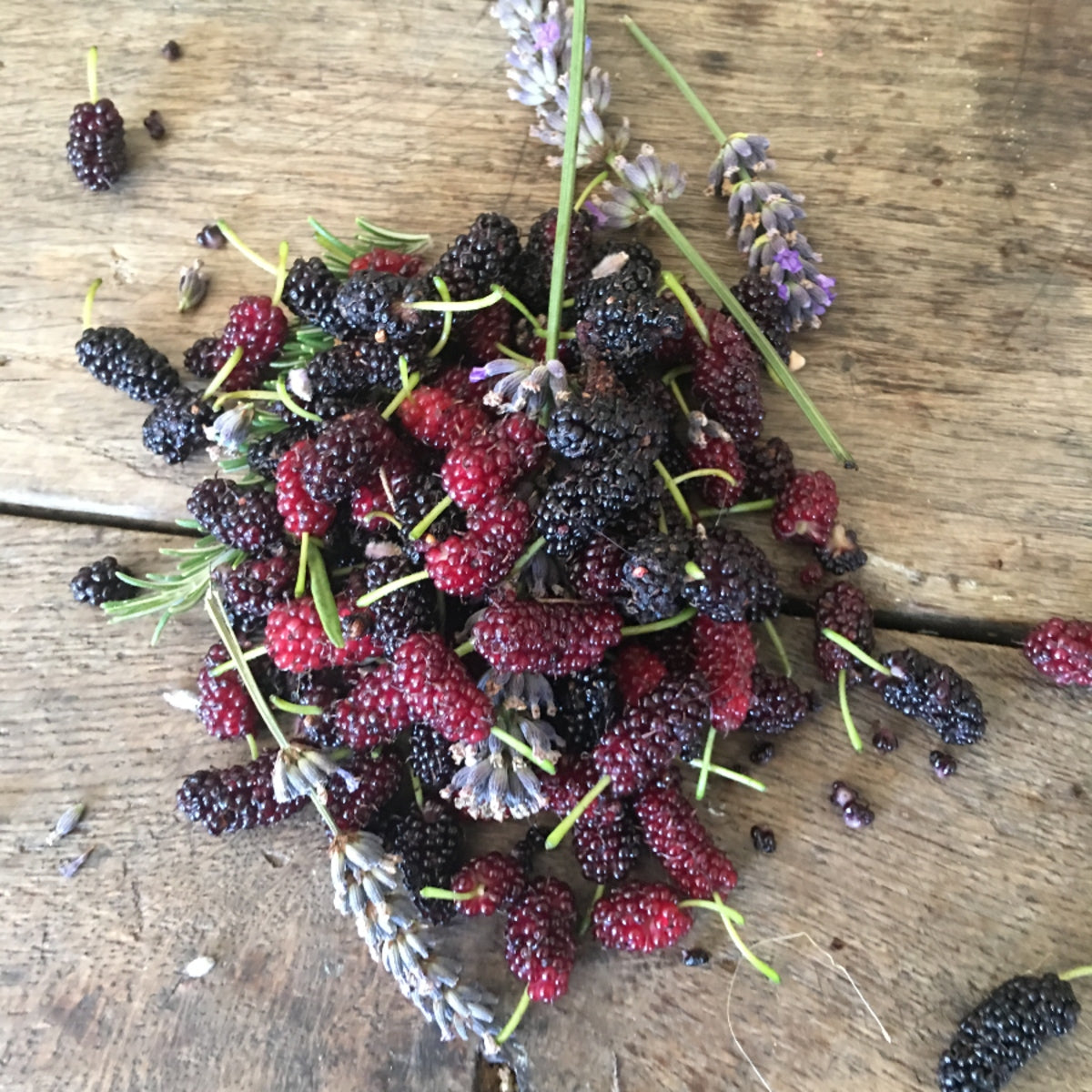
Walk beneath a mulberry tree in midsummer and you may never notice it.
Its branches rarely demand attention. The fruit is small. It does not arrive with the fragrance of peaches or the brilliant color of cherries. It stains your hands a deep purple, falls quietly to the ground, and completes its brief season before many people realize it was there at all.
Yet hidden within this unassuming fruit is one of the most remarkable stories in human history.
Long before the Silk Road became known for precious fabrics, spices, and ideas exchanged across continents, it depended upon the mulberry tree.
Silkworms feed almost exclusively upon mulberry leaves. Entire civilizations cultivated forests of these trees, understanding that without them there could be no silk. Trade routes stretching thousands of miles, connecting China with Central Asia, the Middle East, and Europe, were sustained by something as ordinary as a leaf.
Empires prospered because of the quiet generosity of the mulberry.
The tree never became the symbol of that history.
Silk did.
The finished cloth was admired. The craftsmanship was celebrated. The wealth it generated became legendary. Meanwhile, the tree remained rooted in the background, faithfully supporting a story that many would never know.
There is something deeply familiar about that.
Our attention is often drawn toward what appears extraordinary. We celebrate visible achievements, dramatic transformations, and moments that announce themselves loudly. We are far less likely to notice the quieter qualities that make those moments possible.
Nature rarely shares that preference.
A mulberry tree does not compete with the orchard beside it. It does not hurry its fruit or question whether another tree has produced a more impressive harvest. It simply continues participating in the season according to its own nature.
Perhaps this is why the mulberry has remained so compelling throughout history.
Its greatest contribution was never its ability to attract attention. It was its willingness to fulfill the role only it could fulfill.
The fruit itself carries a similar lesson.
Fresh mulberries possess a remarkable depth that surprises those encountering them for the first time. Their flavor moves between blackberry, black cherry, summer earth, and wine, revealing far more complexity than their modest appearance suggests. They remind us that extraordinary character often exists beneath an ordinary exterior.
At Violet Flame, we found ourselves returning to the mulberry while creating this month's Meadow Collection.
Its history felt inseparable from the conversation we wanted this collection to hold.
The Silk Road truffle pairs mulberry with IGP Piedmont hazelnut and buckwheat honey, ingredients chosen not only for the harmony they create together, but for the story they continue. Together they speak of nourishment, patience, craftsmanship, and the quiet confidence found in allowing one's gifts to exist without constant validation.
The mulberry became a reflection on self-worth.
Not because it struggled to become something greater.
Because it never needed to.
Many of the qualities that define our lives become so familiar that we stop recognizing them. The abilities that come naturally to us often feel ordinary simply because they have always been present. We assume they carry little value because they require so little effort.
Nature suggests another possibility.
The mulberry does not ask permission to ripen.
It does not compare itself with neighboring fruit before deciding whether it deserves its place in the meadow.
It simply fulfills its purpose, trusting that what it has been given is already enough.
Perhaps our own gifts ask for the same quiet confidence.
Perhaps the qualities that feel most ordinary within us are the very ones the world has been waiting to receive.

Leave a comment
This site is protected by hCaptcha and the hCaptcha Privacy Policy and Terms of Service apply.